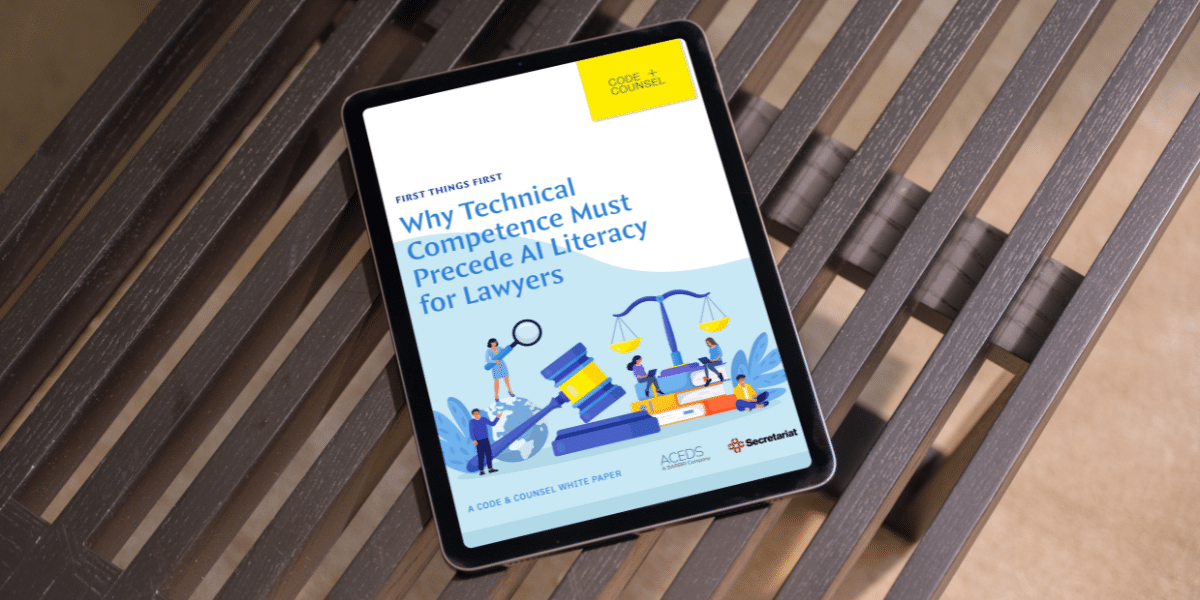
Report explores how gaps in technology competence are shaping the legal profession’s approach to artificial intelligence.
A new white paper from ACEDS’ Code & Counsel working group asks whether lawyers have the technical competence to use rapidly advancing AI tools in legal research, drafting, discovery, and client service workflows.
The report, “Why Technical Competence Must Precede AI Literacy for Lawyers,” sets out the central argument: lawyers cannot develop meaningful AI literacy without first building strong fundamental technology skills. It stresses that understanding the existing technologies supporting legal work is essential for the responsible adoption and use of artificial intelligence in the profession.
“This is something we’ve been hearing consistently across the legal industry,” said Maribel Rivera, Vice President of Strategy and Client Engagement at ACEDS and a member of the Code & Counsel working group. “Not just within the Code & Counsel discussions, but at conferences, client conversations, and industry events over the past few years, even as recently as last week. There’s enormous interest in AI, but there’s also a growing recognition that lawyers need a strong foundation in the technologies they already use before they can rely on AI in practice.”
The paper was developed by the Code & Counsel working group, a collaborative initiative supported by the Association of Certified E-Discovery Specialists (ACEDS) and Secretariat, that brings together practitioners from across the legal ecosystem to examine emerging issues at the intersection of law, technology, and professional responsibility.
“The legal industry doesn’t have an AI problem, it has a sequencing problem. Lawyers are racing to adopt AI tools without fully understanding the systems, data, and workflows those tools depend on”, said Richard Finkelman, Managing Director at Secretariat. “This white paper provides a practical roadmap for firms and legal departments to build AI literacy the right way by strengthening technical competencies first.”
“Artificial intelligence is rapidly becoming embedded in legal practice, influencing research, drafting, discovery, and client service delivery,” the report notes.
“As adoption accelerates, lawyers face growing expectations to demonstrate AI literacy. At the same time, persistent gaps in baseline technology competence remain unresolved across much of the profession.”
Insights in the paper were also shaped by discussions held during ACEDS’ E-Discovery Day webinar, where members of the working group examined how responsible AI adoption depends on a broader understanding of legal technology, data governance, and professional oversight.
The report makes clear that the legal profession’s real challenge is not deciding whether to use artificial intelligence, but rather ensuring its integration into existing systems and workflows is both responsible and effective.
“AI systems operate on data, workflows, and permissions that lawyers already control through existing technologies,” the paper explains. “Without fluency in core systems and workflows, lawyers cannot evaluate AI outputs, supervise automated processes, or explain technology-driven decisions to clients and courts.”
Recent incidents involving unverified AI-generated legal citations and other technology-related missteps have drawn increased attention to the risks of adopting new tools without adequate oversight.
“When AI is layered onto weak technical foundations, it magnifies errors, accelerates risk, and undermines professional judgment,” the report states.
The authors encourage modernization, but stress that establishing technical competence is the essential first step toward responsible AI use in legal practice.
“Technical competence must be treated as an operational baseline,” the report concludes. “AI literacy should be built on that foundation through structured training, readiness assessments, and clear governance controls.”
The full white paper will be released in conjunction with Legalweek 2026 and will be available on the ACEDS and Secretariat websites. Individuals attending Legalweek from March 9 – 12, 2026, can pick up a copy of the white paper or download a digital version at ACEDS’ booth #609 on the exhibit floor.
About Code & Counsel
Code & Counsel is a working group launched by the Association of Certified E-Discovery Specialists (ACEDS) in collaboration with Secretariat to examine the intersection of artificial intelligence, legal technology, and professional responsibility. The initiative brings together legal practitioners and industry experts to explore how AI is being integrated into legal practice and to develop practical insights and educational resources that support responsible adoption across the legal profession.
About Secretariat
Secretariat experts are trusted in the highest-stakes legal, risk, and regulatory matters around the world. Renowned law firms, leading corporations, and respected governmental entities turn to our more than 600 disputes, investigations, economic, engineering, and data advisory experts when the stakes are high— supporting them with meticulous preparation, insightful analysis, and clearly persuasive communications.
Our bright minds and passionate problem-solvers put their financial, analytical, and strategic insights to work in the fast-paced sectors we serve – from construction and energy to healthcare, technology, and natural resources.
Quality, integrity, and independence are woven into every aspect of our work. But, most importantly, when success is on the line, our globally integrated teams thrive on working through the most daunting problems in ways that remove uncertainty and instill confidence. Learn more at www.secretariat-intl.com.
About ACEDS
The Association of Certified E-Discovery Specialists (ACEDS), part of leading legal education provider BARBRI Global, is the world’s leading organization for training and certification in e-discovery, information governance, and related disciplines. ACEDS provides training to corporate legal departments, law firms, the government, service providers, and institutions of higher learning.
Our flagship CEDS certification is recognized worldwide and used to verify skills and competence in electronic discovery for organizations and individuals through training, certification, and continuing education. The CEDS credential is held by practitioners at the largest Fortune 500 companies, Am Law 200 firms, and government agencies. ACEDS has 30 chapters in most major US cities, Canada, the UK, Ireland, the Netherlands, South Africa, and Australia. Our goal is to help professionals and organizations reduce the costs and risks associated with e-discovery while helping to improve and verify their skills and advance their careers and overall technology competence in e-discovery and related fields.