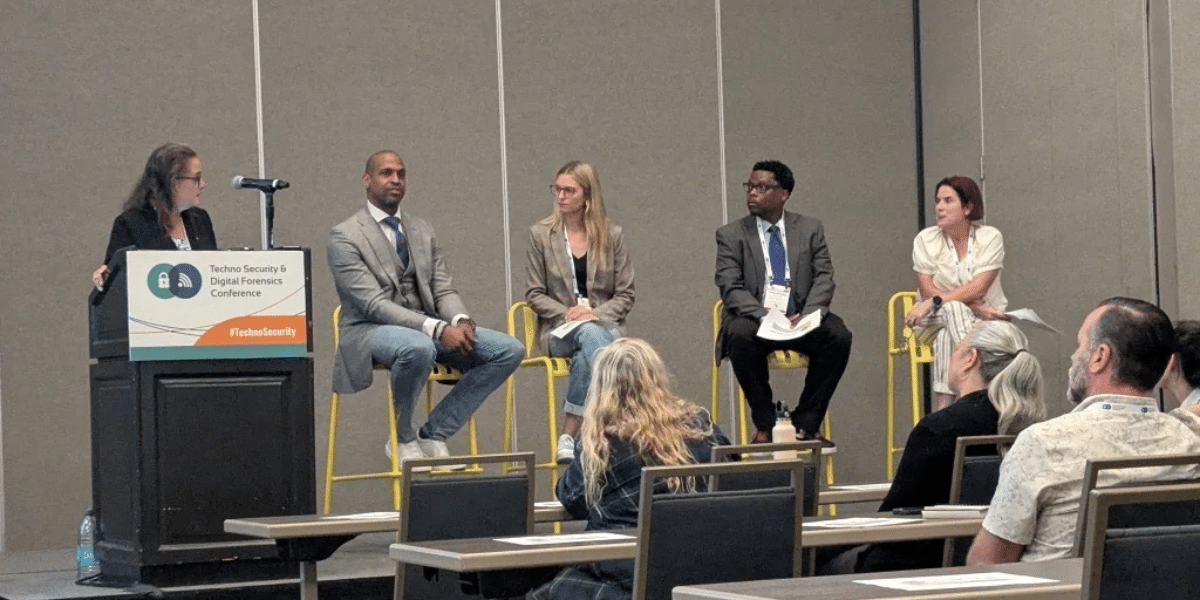
Discovery readiness begins long before a lawsuit or investigation. That message kept resurfacing as I moderated a panel on, Where We Were: Where We’re Are Going: Information Governance and the New EDRM 2.0, at the Techno Security & Digital Forensics Conference in San Diego on behalf of ACEDS. Joining me was Bobby Williams from IDS, Lauren Doucette from Sheppard Mullin, Andy Alcindor from Fish & Richardson, P.C. and June Hunter from Disco. With all the discussion on AI these days, we decided to look at the new EDRM 2.0 Model and where we have come from since 2005 when the first model came out.
We started off by looking back at the original Electronic Discovery Reference Model. It gave us a familiar starting point for discussing how the information environment, and the work of eDiscovery professionals, has changed. Who would have thought that 20 years later, we must look at not only the .pst files, but mobile devices, cloud platforms, collaboration tools, messaging applications, IoT, and information stored in places no one initially thinks to mention.
As we moved into EDRM 2.0, the conversation quickly became practical. What happens when the data cannot be accessed? Who should collect it? What do we do when the records tell us something is missing? And who needs to be part of those conversations before a matter arises?
Four changes with practical consequences
Our discussion focused on four changes in EDRM 2.0:
- the grouping of identification, preservation, collection and processing within Data Acquisition
- the Information Governance Reference Model as the foundation
- analysis extending across the discovery lifecycle
- disposition as a distinct phase.
Governance and analysis were already part of discovery work and the earlier model. Their broader placement in the updated model makes their continuing role more visible. For practitioners, these changes invite a closer look at how decisions connect throughout a matter.
Readiness can be lost years before collection
Some of the most instructive examples involved decisions made well before a legal matter commences. Panelists described encrypted devices that could not be accessed, backups that could not be unlocked, and email archives whose components could not be reconstructed.
By the time a discovery professional encounters those problems, the available options may be limited. A system can meet an immediate business need while creating serious difficulties when information must later be preserved, retrieved or explained.
Those stories made the case for bringing discovery and governance expertise into technology decisions earlier. Before selecting, migrating or retiring a system, the organization needs people asking how its information will remain accessible and usable.
Collection requires an informed choice
The panel offered different perspectives on collection. Some speakers emphasized the value of forensic providers who understand collection methods and can explain their work if it is challenged. Others described trained internal teams using Microsoft Purview and other cloud tools to perform collections.
That discussion matters because there is no single staffing answer for every matter, as each matter has different requirements. A trained internal professional performing a documented export presents a different situation from a custodian choosing which records to send to counsel.
The questions are practical: Who understands the source? Who has the necessary training and access? Could bias affect the work? Who can explain what was collected and how? Is the collections defensible in court and can someone testify to it? Should you let the client self-collect to save costs? The apparent savings from performing a self-collection can disappear quickly if the team later must repair missing or altered information.
Analysis means following the gaps
The panel’s discussion of continuous analysis reflected how discovery actually unfolds. A newly identified custodian, an unexpected messaging application, or an unexplained gap can send a team back to an earlier activity.
One example stayed with me. An executive initially identified four people involved in a project. Follow-up with an assistant revealed ten more people and an offsite location containing paper records. Another example described finding important emails on retired computers after searches of active systems and cloud sources had failed to locate them.
These show the value of asking questions in everyday language. Asking whether someone texted about a transaction may be more productive than asking them to identify all potentially relevant data sources.
AI can help practitioners understand unfamiliar datasets, identify key people, and develop questions. The panel also emphasized verification. Faster analysis still requires checking results and investigating what does not fit.
Disposition deserves a conversation
Disposition generated a useful discussion about practice differences. For teams handling intellectual property or trade secret matters, returning or destroying information can involve close coordination with risk and compliance professionals. Keeping data unnecessarily can also create additional hosting costs and risk.
Giving disposition its own place in the model encourages teams to discuss what happens to matter data after use: what should be retained, returned, transferred or deleted, and which preservation requirements still apply. Those decisions require coordination and appropriate authorization.
A shared model needs shared understanding
The panel did not agree on every aspect of the revised visual. Some saw a clearer representation of iterative discovery work. Others found the original model easier to use when teaching new attorneys or connecting discovery concepts to other disciplines.
That difference is worth keeping in the conversation. A reference model has to work for people with different responsibilities and levels of technical knowledge. Attorneys, paralegals, IT professionals, cybersecurity teams, forensic specialists and e-discovery practitioners may approach the same information from very different perspectives.
The model can help them begin a conversation. They still need to establish who authorizes a hold, who implements it, who manages access and who confirms that the necessary information can actually be retrieved.
The work begins before the request
As we closed, we returned to a consistent theme: communicate early, communicate often, and involve the right people before a problem develops. That includes transactional professionals. The records that become evidence usually originate in everyday business activity, well before anyone anticipates a dispute.
For me, the practical value of this discussion was the reminder to bring readiness into the decisions organizations already make. A system change, a custodian interview, a retention decision or a conversation with IT can be the point at which a later discovery problem is prevented.
EDRM 2.0 gives us a framework for those conversations. The next step is to have them while there is still time to act.


Passionate about educating and mentoring others, Marla has become a sought-after speaker and panelist for MCLE events, focusing on eDiscovery best practices, particularly for small law firms that may not have the resources of larger firms. As a Certified eDiscovery Specialist (CEDS) with both the eDiscovery Executive Certificate (eDEx) and eDiscovery Advanced Certificate (eDAdv), she brings a wealth of knowledge to her presentations and consulting work.
Currently, Marla is an active member and/or board member of several legal associations in Southern California, ACEDS Orange County, serving as the Founding President and now Immediate Past President, and Women in eDiscovery (WiE) in both Orange County and San Diego, where she has held various board and committee positions. She is also on the Advisory Board for Life Preservers Project, raising awareness for human trafficking and creating pathways to healing for its survivors. In addition, Marla is also on the board of directors for her high school alumni association to help raise money for the school and her class reunion committee.
Marla obtained her Bachelor of Arts degree from the University of the Pacific and her paralegal certificate from the University of California - Irvine. She is an avid San Diego sports fan, event planner, reader, and outdoor enthusiast who spends her free time with her English Springer Spaniel, Jazmin.