
A keynote on the human challenge ahead, where AI, human judgment, and the future of work converge.
At this year’s CLOC Global Institute, former OpenAI Head of Go-to-Market Zack Kass delivered a keynote that was less about technology adoption and more about something far larger: how people, organizations, and communities will navigate a world increasingly shaped by artificial intelligence.
While much of the current AI conversation centers on productivity gains, automation, and operational efficiency, Kass approached the topic from a more human perspective. His keynote explored what happens when intelligence itself becomes abundant, how work changes as AI becomes embedded in everyday life, and why human judgment may become even more important in the years ahead.

For professionals across legal operations, e-discovery, investigations, information governance, compliance, and legal data intelligence, the keynote raised timely questions the industry is already grappling with: how to balance innovation with defensibility, efficiency with oversight, and automation with trust.
Early in the keynote, Kass reframed the AI conversation, instantly shifting the tone in the room.
“We’re building machines that possess human-level intellectual capability and superiority.”
Rather than focusing on demos or flashy product capabilities, Kass argued that the industry has reached a point where AI can no longer be viewed as merely another software feature or productivity tool. The pace of advancement has become too significant, and the implications too broad.
He traced that acceleration from the evolution of machine learning models in the early 2000s to the release of transformer-based systems and the emergence of generative AI platforms, which rapidly changed public awareness of what machines could do. But for Kass, the real turning point came when AI systems began outperforming humans in areas previously associated with elite intellectual capability.
At that moment, he explained, he fundamentally changed the conversation.
What followed throughout the keynote was neither a prediction of technological doom nor a simplistic argument that AI will solve everything. Instead, Kass framed AI as a societal and operational challenge that compels organizations to reconsider how humans work, what they value, and where human contribution matters most.
That idea surfaced repeatedly in his discussion of what he called the “automation boundary.”
“If you could automate everything in your life, where would you stop?”
The answers he shared to that question drew laughs at first, but it quickly became one of the keynote’s most compelling themes.
Kass argued that the future challenge for organizations will not simply be identifying what can be automated. It will be determining what should remain human. That distinction is especially relevant in legal environments, where workflows increasingly intersect with AI-driven review, analysis, summarization, research, and decision support.
For legal operations and e-discovery professionals, the idea feels especially timely. The industry has already spent years balancing automation with defensibility. Technology-assisted review, analytics, workflow automation, and AI-enhanced investigations have long required professionals to establish governance frameworks for quality control, validation, oversight, and human review.
In many ways, the legal industry has already been testing the automation boundary for years.
Kass also challenged the audience to think beyond AI as a standalone tool and instead view it as infrastructure, a utility that is becoming embedded in every layer of business and society.
“We are approaching what I can best describe as unmetered intelligence.”
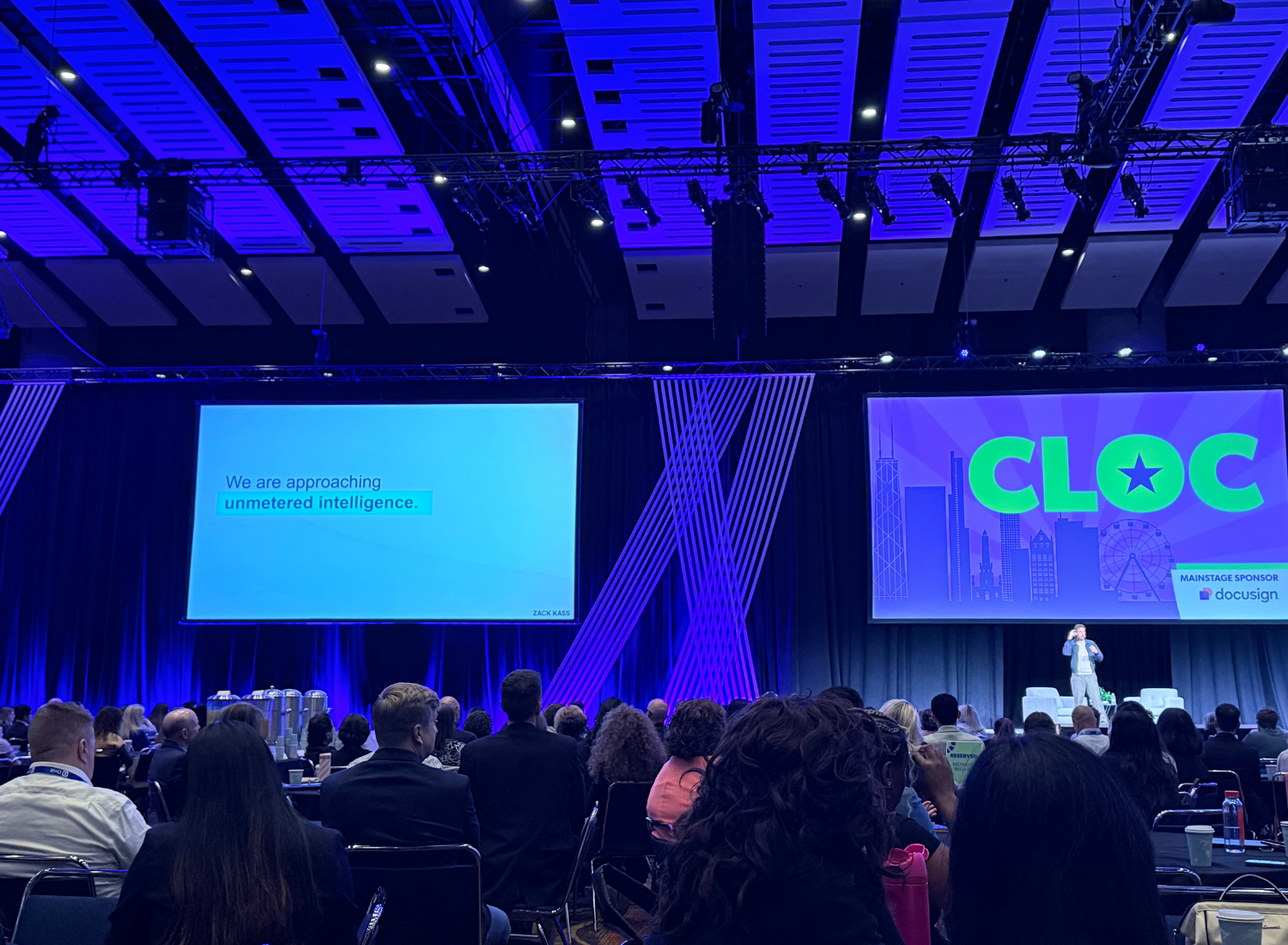
That concept, intelligence becoming abundant and increasingly commoditized, may ultimately have profound implications for the professional services industries.
Historically, expertise itself was a differentiator. But if intelligence becomes broadly accessible, the competitive advantage may shift to something else entirely: judgment, trust, creativity, communication, ethics, governance, and the ability to apply knowledge responsibly in highly contextual environments.
That shift could prove especially important in legal operations and e-discovery, where success has never depended solely on access to information. It depends on interpretation, defensibility, strategic thinking, and the ability to navigate ambiguity under pressure.

Kass repeatedly returned to the idea that technological acceleration does not eliminate the human element. Instead, it changes where humans provide value.
He also spent considerable time discussing autonomous agents: systems capable of executing tasks across applications, workflows, and data environments with minimal human intervention. While many organizations are still experimenting with generative AI at the application layer, Kass suggested that a broader operational transformation may emerge as AI agents begin interacting directly with systems, information, and workflows on users’ behalf.
That future, he argued, may fundamentally reshape how people interact with the internet itself.
“The optimal state of the internet in the next 5 to 10 years is an XML/TXT internet, not an HTML browsable one.”
The idea may sound abstract, but its implications are significant. Rather than humans manually navigating endless interfaces, dashboards, and systems, AI agents may increasingly retrieve, organize, summarize, and move information autonomously.
For legal and compliance professionals already overwhelmed by expanding data volumes, fragmented communication platforms, privacy obligations, and increasing information complexity, the concept feels less theoretical than it might have only a few years ago.
At several points during the keynote, Kass also acknowledged the growing trust gap surrounding AI adoption. While AI usage continues to increase, public skepticism about large technology companies, data use, social media, and digital dependency remains strong.
That tension surfaced clearly when Kass discussed screens, digital overload, and the unintended societal consequences of modern technology.
“We sacrificed the souls of your children at the altar of digital distraction.”
It was one of the keynote’s sharper moments, but it reinforced a broader point: AI conversations are no longer purely technical. They are operational, cultural, ethical, and deeply human.
That reality increasingly places professionals responsible for governance, legal operations, investigations, compliance, privacy, records management, and e-discovery in a uniquely important position. As organizations integrate AI into workflows and decision-making, the need for professionals who understand defensibility, transparency, accountability, and information management becomes even more critical.
Kass also emphasized that adaptability and continuous learning will be defining factors in the years ahead.
When discussing workforce transformation, he pushed back against incremental thinking and urged organizations to look far beyond small efficiency gains.
“These tools aren’t required to get marginally better. They’re required to get way better.”
That mindset may ultimately become one of the most important differentiators for organizations successfully navigating AI adoption. The conversation is no longer simply about purchasing technology. It is about redesigning workflows, rethinking how work happens, and preparing professionals to operate effectively in environments where AI capabilities continue to evolve rapidly.
At the same time, Kass resisted framing the future solely through fear or disruption. In fact, optimism became one of the keynote’s defining themes.
Near the end of the session, he challenged attendees to move beyond constant digital negativity and focus on building stronger communities, healthier workplaces, and more meaningful human experiences alongside technological advancement.

“People want to get off their screens. People want to go outside. People want to hear good stories. And people want to tell good stories.”
That perspective may ultimately explain why the keynote stood out in the broader AI conversation today. Kass did not present AI as purely a legal, business efficiency, or even a technology issue. He presented it as a human challenge, one that forces organizations and individuals alike to decide what they value, what they preserve, and how they want technology to shape the future of work.
For the legal industry, that conversation is already underway. Across legal operations, e-discovery, investigations, privacy, compliance, and legal data intelligence, professionals are increasingly being asked not only how to use AI but also how to use it responsibly, transparently, and effectively.
The next renaissance Kass described may ultimately depend less on the technology itself and more on the people responsible for guiding it.